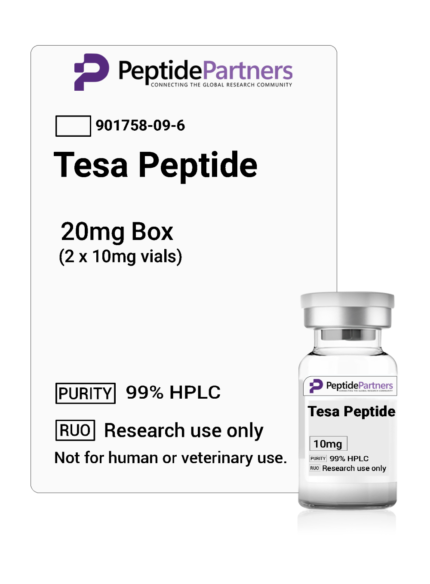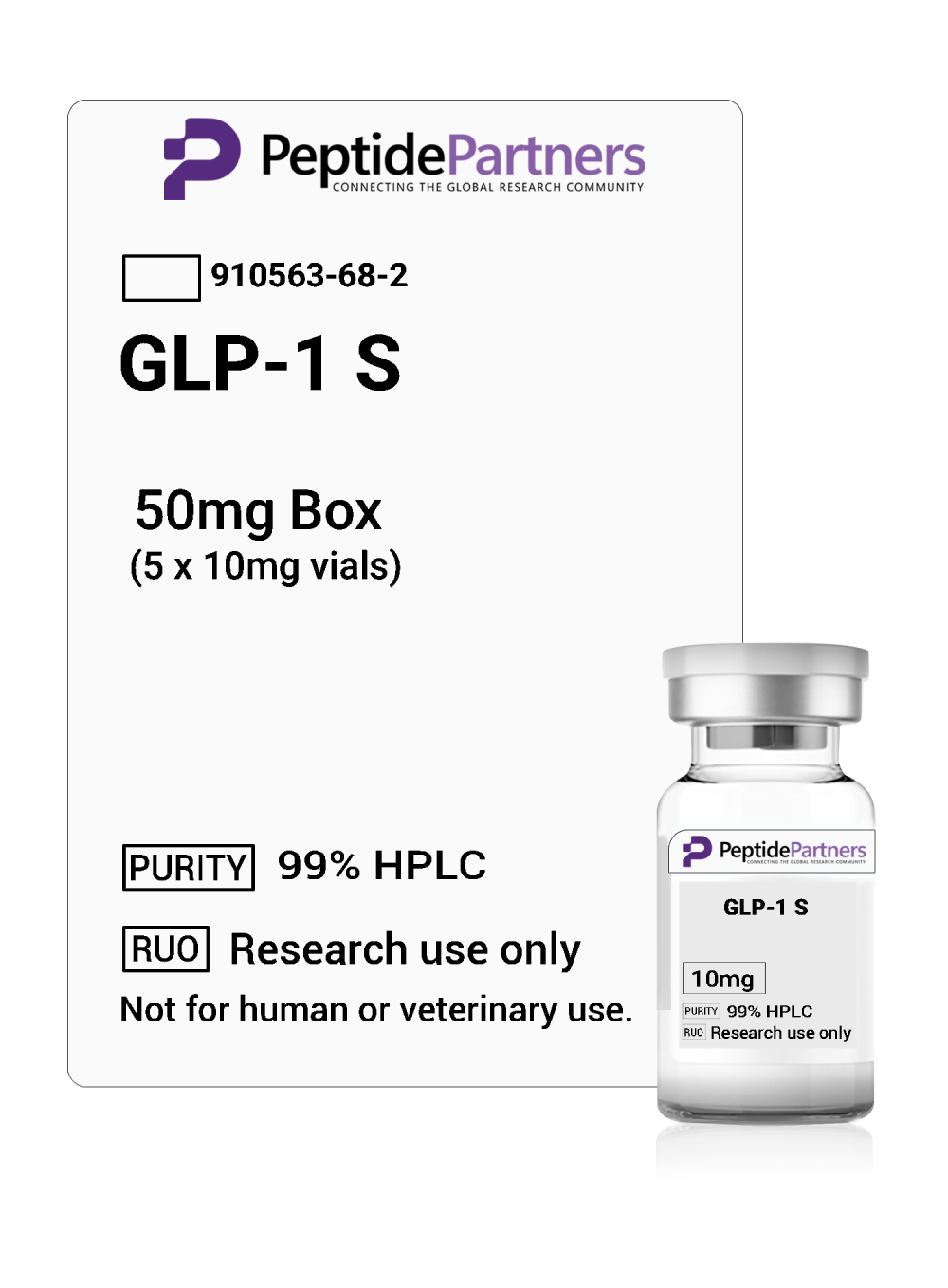


GLP-1 Semaglutide (10mg vials)
Price range: $285.00 through $976.00
-
Research peptide: GLP-1 Semaglutide, a long-acting GLP-1 receptor agonist research compound.
-
Research focus: GLP-1 receptor signaling, bone-derived mesenchymal stem-cell biology, mitochondrial function, skeletal-muscle metabolism, autophagy, apoptosis, and preclinical research.
-
Format: 10 mg vials with 3 mL vial capacity.
-
Available box combinations: 50 mg, 100 mg, 150 mg, and 200 mg.
-
Purity: 99.82% multi-vial purity.
-
Testing status: Doubly validated and independently tested; purity, endotoxin, and heavy-metals screenings passed.
-
Batch details: Manufacturer ID VI32; batch SM202607.
-
Research context: Published studies have examined semaglutide in bone-marrow-derived cell cultures, C2C12 myotubes, and SH-SY5Y neuronal-cell models.
- Independent certificate details, manufacturer IDs, and batch IDs should be reviewed before purchase when available.
- Order cancellations for full refunds are available before shipment; shipped orders cannot be cancelled or refunded.
- For damaged or incorrect goods, photograph the outer packaging, inner packaging, and product labels, then email support within 48 hours of carrier delivery.
Buy GLP-1 Semaglutide – Peptide Partners
Product Overview & Specifications
GLP-1 Semaglutide is a long-acting glucagon-like peptide-1 receptor agonist research compound supplied by Peptide Partners for in-vitro testing, laboratory experimentation, receptor-signaling research, cellular metabolism studies, and preclinical investigation.
Published research has examined semaglutide in bone-derived mesenchymal stem cells, skeletal-muscle myotubes, and SH-SY5Y neuronal-cell models. Research areas include Wnt/LRP5/β-catenin signaling, osteogenic differentiation, mitochondrial function, insulin-signaling markers, autophagy, apoptosis, and amyloid-beta-associated cellular stress.
These findings are limited to laboratory cell systems and do not establish human safety, clinical efficacy, or suitability for treatment. Researchers should review the applicable batch documentation and certificate of analysis before beginning any experiment.
Product Specifications
| Specification | Details |
|---|---|
| Product name | GLP-1 Semaglutide |
| Compound type | Long-acting GLP-1 receptor agonist research compound |
| Primary research target | Glucagon-like peptide-1 receptor (GLP-1R) |
| Primary research areas | Cellular signaling, osteogenic differentiation, mitochondrial biology, autophagy, apoptosis, and metabolic research |
| Product format | 10 mg vials |
| Vial size | 10 mg |
| Vial capacity | 3 mL |
| Available box combinations | 50 mg, 100 mg, 150 mg, and 200 mg |
| Multi-vial purity | 99.82% |
| Validation | Doubly validated |
| Independent testing | Yes |
| Endotoxin screening | Passed |
| Heavy-metals screening | Passed |
| Purity screening | Passed |
| Manufacturer ID | VI32 |
| Batch ID | SM202607 |
| Cost per milligram | $4.88–$5.70 |
The stated 99.82% purity is based on multi-vial testing. Researchers should review the batch-specific certificate of analysis before beginning any experiment.
Primary Research Studies & Findings
Semaglutide Promotes the Proliferation and Osteogenic Differentiation of Bone-Derived Mesenchymal Stem Cells Through Activation of the Wnt/LRP5/β-Catenin Signaling Pathway
Authors: Yawei Tian, Huiming Liu, Xiaoxue Bao, and Yukun Li
Publication: Frontiers in Pharmacology, 2025;16
DOI: 10.3389/fphar.2025.1539411
Reference: View publication
This in-vitro study examined semaglutide in bone-derived mesenchymal stem cells obtained from rats. The researchers assessed cellular proliferation, alkaline-phosphatase activity, mineralized-nodule formation, migration, apoptosis, and expression of osteogenic markers.
Semaglutide exposure was associated with increased proliferation and osteogenic differentiation under selected experimental conditions. The study reported higher alkaline-phosphatase activity, increased mineralization, and elevated expression of osteocalcin and RUNX2. RNA sequencing and pathway experiments implicated Wnt/LRP5/β-catenin signaling, while DKK1 and lithium chloride were used to inhibit or enhance pathway activity.
The study used concentrations of 10, 100, and 1,000 nM, with 100 nM identified as the most active concentration for several tested endpoints. The authors noted that the findings require in-vivo validation and do not establish bone-related effects in humans.
Plain-English Research Summary
This laboratory study examined semaglutide in cultured rat bone-derived stem cells. The researchers observed changes in cell proliferation, mineralization, and bone-related markers and linked those responses to the Wnt/LRP5/β-catenin pathway. The findings are limited to a cell-culture model and do not establish a human bone-health or treatment effect.
The Effect of Semaglutide on Mitochondrial Function and Insulin Sensitivity in a Myotube Model of Insulin Resistance
Authors: Emmalie R. Spry, Kipton B. Travis, Kayla J. Ragland, Alexa J. Klein, John M. Zimmerman, and Roger A. Vaughan
Publication source: Molecular and Cellular Endocrinology, 2025
Reference: View publication
This study evaluated semaglutide in C2C12 mouse myotubes, including a cell-culture model of insulin resistance. The researchers measured insulin signaling through the pAkt-to-Akt ratio and assessed mitochondrial and glycolytic metabolism, metabolic-gene expression, mitochondrial content, and cellular lipid content.
At the tested pharmacokinetically relevant concentration of 10 nM for 24 hours, the study reported no significant changes in insulin signaling, mitochondrial function, mitochondrial content, glycolytic metabolism, or related gene expression. The authors contrasted these results with prior studies using higher semaglutide concentrations and noted that concentration differences may help explain the inconsistent findings.
Plain-English Research Summary
This study tested semaglutide in cultured muscle cells under insulin-resistance conditions. At the concentration and exposure time used, the researchers did not observe significant changes in mitochondrial activity or insulin signaling. The results demonstrate why concentration, exposure duration, and model selection are important when interpreting semaglutide research.
Semaglutide-Mediated Protection Against Aβ Correlated With Enhancement of Autophagy and Inhibition of Apoptosis
Authors: Yan-fang Chang, Di Zhang, Wei-min Hu, Dong-xing Liu, and Lin Li
Publication source: Neuroscience Letters, 2021
Reference: View publication
This in-vitro study used SH-SY5Y human neuroblastoma cells exposed to amyloid-beta 25–35 as an experimental model of amyloid-associated cellular stress. The researchers evaluated cell viability and markers associated with autophagy and apoptosis after semaglutide treatment.
The study reported that semaglutide partially restored cell viability under the tested amyloid-beta conditions. It also described changes in autophagy-associated markers, including LC3, Atg7, Beclin-1, and p62, together with changes in apoptosis-related proteins such as Bcl-2 and Bax.
These findings describe protein-marker changes in a transformed cell-line model exposed to a synthetic amyloid-beta fragment. They do not establish neuroprotection, prevention of neurodegenerative disease, or clinical benefit in humans.
Plain-English Research Summary
This cell study examined semaglutide in a laboratory model of amyloid-beta-associated stress. The researchers observed changes in cell viability, autophagy markers, and apoptosis-related proteins. The results are exploratory and mechanistic and should not be presented as evidence of a human neurological treatment effect.
Standard Research Disclaimer
Research Use Only. Not for use in diagnostic tests.
This product is solely intended for research purposes as a chemical compound. It is designated exclusively for in-vitro testing and laboratory experimentation. All information provided about this product is educational and should be evaluated by appropriately qualified research personnel.
By law, bodily introduction of this product into humans or animals is strictly prohibited. This compound must not be used, administered, or represented as a drug, food, dietary supplement, weight-management product, diagnostic material, neuroprotective product, or medical treatment. It is not intended to diagnose, treat, cure, or prevent any disease. It should be handled only by licensed and qualified professionals in an appropriately equipped laboratory and in accordance with applicable laws, institutional procedures, and relevant safety requirements.
| Choose pack |
5 vials × 10mg (50mg total) ,10 vials × 10mg (100mg total) ,15 vials × 10mg (150mg total) ,20 vials × 10mg (200mg total) |
|---|
- All of our manufacturing partners produce peptides using the Lyophilization (Freeze Drying) process, ensuring products maintain stability for shipping and storage for 12+ months.
- In lyophilized form, they are shelf-stable for many weeks. However, for long-term storage, it is recommended to store them in the freezer.
- We often hear concerns about the standard "discard after 28 days of first use" disclaimer. Don't worry, this has nothing to do with studies regarding the efficacy of specific peptides. 28 days is the FDA requirement for producers of multi-use vials to prove their bacteriostatic maintains efficacy. This minimum requirement becomes the de facto standard.
- In our experience, if you use proper sterile procedures and refrigerated storage, you can continue sampling from the same reconstituted vial for 3+ months.
Certificate records
No published certificate records are available for this product.
Search Certificate LedgerRelated products

5-Amino-1MQ (10mg vials)
Price range: $56.00 through $195.00
Cagrilintide (10mg vials)
Price range: $335.00 through $1,050.00
GLP-2 Tirzepatide (40mg vials)
Price range: $260.00 through $3,090.00
GLP-3 Retatrutide (24mg vials)
Price range: $230.00 through $1,512.00
Ipamorelin (10mg vials)
Price range: $82.00 through $577.00
Sermorelin (10mg vials)
Price range: $98.00 through $797.00